


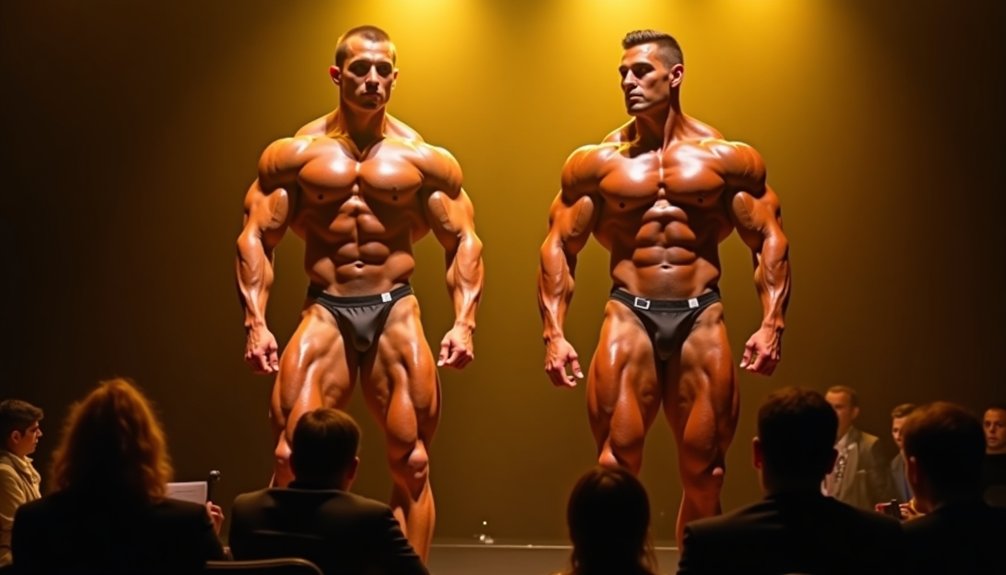
The mandatory sequence carries significant weight across divisions. Men’s Bodybuilding requires the front double biceps, front lat spread, back double biceps with open hands, and the most muscular, among others. Classic Physique integrates the side chest with arms extended and places strong emphasis on V-taper and waist control throughout every pose. Men’s Physique operates through quarter turns without the most muscular, making presentation and proportion the primary differentiators. Each division’s mandatory structure is designed to expose specific physical qualities, and a competitor who executes those poses with precision, clean muscle delineation, and balanced symmetry scores more favorably than one with comparable size but poor control.
During comparisons and callouts, the Chief Judge assembles groups of three to ten athletes, with the top five compared first. The Head Judge directs quarter turns and mandatory poses, and all competitors are compared at least once. In close contests, these repeated comparisons force judges to measure athletes against one another in real time, and posing quality under that sustained scrutiny directly influences scoring. An athlete who maintains stage presence, correct anatomical alignment, and poise across multiple callouts holds an advantage that raw muscularity alone cannot compensate for.
Free posing routines, capped at 90 seconds and performed only by top finalists, allow additional differentiation. Judging accounts for choreography, smooth shifts, and artistic presentation alongside the competitor’s music choice. Athletic bearing, overall shape, and harmonious proportions are evaluated as a total package rather than isolated attributes.

Skin tone, tan quality, and absence of surgical enhancements also factor into assessment, as do proportion, muscle contours, and body fat levels. The standard favors a classical, harmonious physique over extreme shredding or blocky shapes. Posing trunks must display numbering correctly, and poise alongside complexion remain scored elements.
In competitive fields where muscular development converges, these presentation variables accumulate into decisive scoring margins, positioning posing mastery as a genuine competitive instrument rather than a secondary consideration. Competitors must also note that judging and finals each contribute equally, accounting for fifty percent of the final score respectively, meaning a strong judging round performance can never be entirely offset by finals alone.