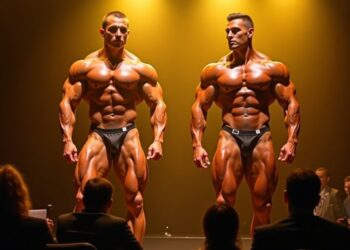


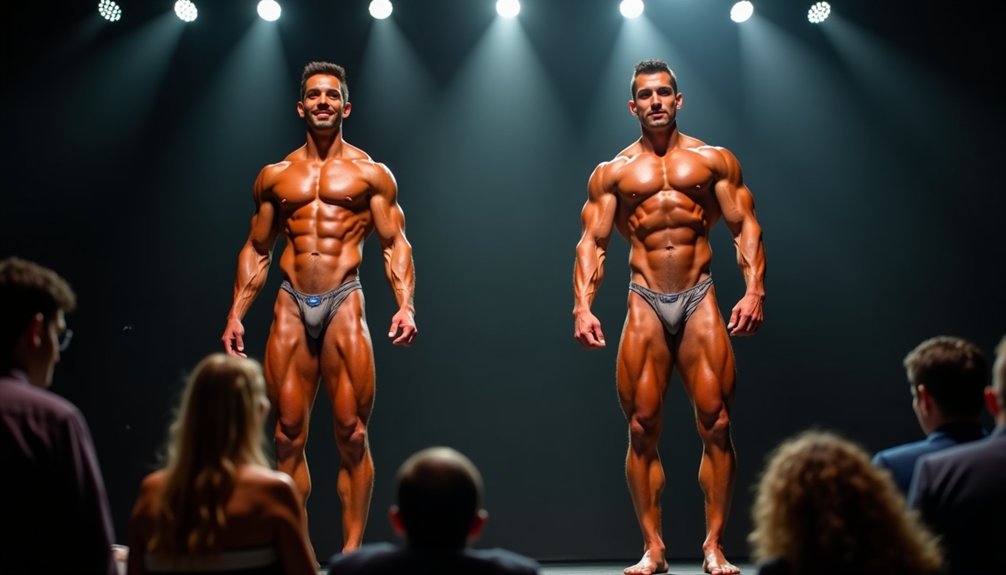
Execution quality carries significant weight in scoring. Judges assess control during held positions, the smoothness of shifts between poses, and the athlete’s stamina in maintaining poses comfortably throughout the round. Clean separation between muscle groups is required, and striations along with vascularity contribute directly to how a pose reads onstage. When two competitors present similar physiques, these technical details frequently determine placement.
Technical precision separates champions — control, smoothness, and stamina determine placement when physiques are equally matched.
Presentation components extend the evaluation beyond muscularity. Stage presence incorporates tan, hair, makeup, and jewellery, while poise, confidence, and athletic posture are scored independently. Personality expressed through confident movement onstage influences how judges perceive an athlete’s overall package. Cosmetic preparation, though superficial in nature, affects scoring in divisions where visual presentation is weighted heavily.
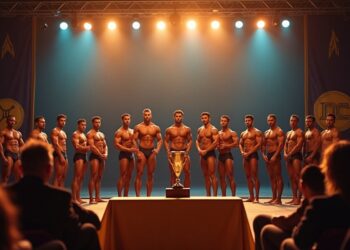
The judging process involves up to 60 seconds per individual mandatory pose, with the head judge directing callouts of three to ten competitors for side-by-side comparisons. Judges assess physiques from head downward, and multiple comparison rounds guarantee every athlete receives adequate evaluation. This structured process creates repeated opportunities for posing ability to influence outcomes.

Division-specific standards further define what effective posing requires. Classic Physique prioritizes flow, symmetry, and V-taper, while Men’s Physique weighs muscularity alongside stage presence. Bikini judges focus on hourglass shape and waist control, and Fit Model competitors are assessed on condition, symmetry, and posing precision. Bodybuilding demands smooth, choreographed routines that demonstrate conditioning across all mandatory sequences.
Common scoring deductions include thick waists, upper-to-lower body imbalance, insufficient conditioning that obscures muscle separation, and overconditioning. In close competitions, athletes who demonstrate superior posing execution, presentation consistency, and division-appropriate aesthetics hold a measurable advantage over equally conditioned competitors. Fit Model competitors are specifically required to wear a plain color spandex or metallic suit with no embellishments such as stones, crystals, or sequins.