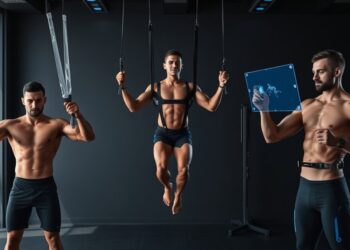



Bodybuilders in 2025 have access to smart fitness tools like the AI-driven Tempo Studio, Speediance Gym Monster, and Tonal 2, which provide real-time coaching, adaptive digital resistance, and thorough progress tracking directly in compact home setups. Advanced wearables and biometric sensors deliver instant physiological feedback, while intelligent kettlebells and EMS devices offer dynamic strength adjustments and enhanced muscle activation. These integrated systems personalize workouts, optimize technique, and help users surpass plateaus—further details reveal how each tool adapts as training evolves.
AI-Powered Smart Home Gyms: The Future of Strength Training
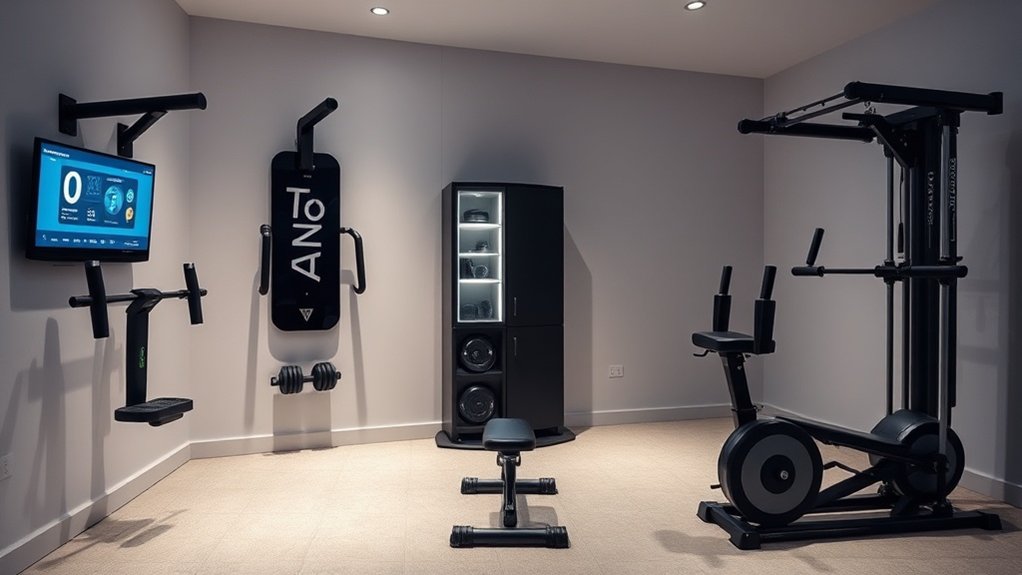
Although traditional gyms remain a staple for bodybuilders, an array of AI-powered smart home gyms is redefining how strength training can be approached outside the commercial fitness space.
These home gyms integrate advanced AI coaching, real-time form correction, and adaptive digital resistance to deliver personalized workouts tailored to individual goals and progress.

Devices like Tempo Studio and Speediance offer full gym setups with free weights, cable systems, and a variety of exercise options, all supported by AI feedback to optimize technique and safety.
Compact designs enable space-efficient installation, making them accessible for home use.
Additional features include automatic workout tracking, community challenges, and virtual trainer guidance, enhancing motivation and convenience for consistent strength training in a nontraditional environment.
Adaptive Resistance Machines With Electromagnetic Technology
As bodybuilding moves further into the era of connected fitness, electromagnetic resistance machines are increasingly recognized for their capacity to adapt resistance levels instantaneously and precisely, leveraging digital technology to mimic—and often surpass—the feel of traditional gym equipment.
These machines use finely tuned motors controlled by software to deliver resistance that matches the user’s effort in real time, eliminating the need for weight adjustments or momentum reliance.
This adaptive resistance guarantees constant muscle engagement through both concentric and eccentric phases, optimizing strength gains and minimizing injury risk.
Their ability to provide eccentric overload and dynamic load drop features enables longer, more effective workouts tailored to individual fatigue levels.
Eccentric overload and dynamic load drop features extend workout duration and effectiveness by adjusting to individual fatigue levels.
Such technology offers measurable progress tracking and enhanced efficiency, reshaping resistance training with superior control and personalization.
Compact, Multi-Functional Smart Weight Systems
Compact, multi-functional smart weight systems consolidate various workout modalities into a single, space-saving device designed to deliver versatile resistance training without bulky traditional weights.
These systems integrate digital resistance technology, often controlled by AI, allowing precise weight adjustments up to 200–250 pounds within a confined footprint. They typically offer multiple workout options including cable exercises, squats, presses, and rows, replacing free weights while maintaining workout variety.
Their compact design suits limited spaces and home gyms, often featuring interactive screens or app connectivity for real-time feedback and guided training.
Notable examples include Tonal and Gym Monster, both providing multi-functional capabilities, smooth operation, and tailored programming, though these come with a higher upfront cost and varying resistance limits that may affect heavy lifters.
Such systems represent an evolution in strength training equipment combining convenience, technology, and versatility.
Advanced Wearable Biometric Trackers and Sensors
Advanced wearable biometric trackers and sensors represent a critical innovation in bodybuilding, providing precise real-time monitoring of key physiological metrics such as heart rate, muscle activation, and motion patterns.
These devices offer insights into rep counts, form analysis, load tracking, and recovery enhancement, enabling lifters to adjust workouts dynamically for peak performance and injury prevention. Many integrate heart rate variability (HRV), sleep quality, and stress levels to promote personalized training and recovery strategies.
Wearable devices deliver insights on rep counts, form, load, and recovery, empowering lifters to adapt workouts for peak performance and injury prevention.
Examples include rings like the Oura Ring Gen 4, which tracks over 30 signals including HRV and sleep stages with long battery life, and sensor-equipped bands that monitor muscle activation and breathing for enhanced biofeedback.
These wearables synthesize data to deliver actionable guidance, transforming bodybuilding through data-driven, personalized fitness management.
Real-Time Exercise Form and Technique Analyzers
Real-time exercise form and technique analyzers utilize advanced sensors and AI algorithms to assess and provide immediate feedback on movement quality during workouts.
These tools track key body landmarks and joint angles using video or wearable sensors, analyzing biomechanical patterns to identify deviations from ideal form. They highlight risky movements and recommend corrections to enhance safety and performance.
Popular systems like FormCheck AI and AiKYNETIX offer detailed, exercise-specific feedback on compound lifts such as squats and deadlifts, using 3D pose estimation to pinpoint subtle issues.
Their real-time alerts help users maintain proper technique, avoid injury, and improve training efficiency without needing personal trainers.
Integration with cameras or smartphones guarantees accessibility for bodybuilders aiming for precise, data-driven improvements during sessions.
Smart Cardio Equipment With Immersive Feedback
How does smart cardio equipment transform traditional workouts with immersive feedback? It integrates visual immersion, interactive virtual environments, and real-time performance metrics to shift cardio from repetitive to engaging experiences.
Users can explore dynamic terrains or global destinations, such as beaches or mountains, enhancing motivation and adherence. Personalized workout adjustments mid-session allow flexibility without interruption, while integrated instructor-led programming offers guidance beyond manual modes.
Devices like the Freemotion Fitness 22 Series and UREVO CyberPad treadmill exemplify this trend by combining HD screens with app connectivity, heart rate tracking, and customizable visual feedback.
This fusion of technology makes cardio workouts more enthralling, promotes consistent effort, and helps gyms differentiate offerings to improve client retention and satisfaction.
Immersive smart cardio equipment effectively redefines cardiovascular training into interactive, motivating journeys.
Interactive, Data-Driven Workout Companion Apps
Interactive, data-driven workout companion apps harness connected device capabilities and artificial intelligence to personalize training, track progress, and enhance user engagement during bodybuilding and general fitness routines.
Apps like Alpha Progression and Dr. Muscle offer tailored workout plans based on individual goals and performance, ensuring progressive overload for muscle development.
These apps provide detailed analytics, allowing users to monitor their progress and adjust workouts accordingly. Features such as AI coaching and automated tracking further streamline the fitness journey.
Additionally, apps like JEFIT and Sworkit offer extensive exercise databases and community support, making them ideal for those seeking a structured and social fitness experience.
Smart Muscle Stimulation and Recovery Devices
Smart muscle stimulation and recovery devices utilize electrical impulses to activate muscle contractions, aiding both muscle strengthening and rehabilitation.
These devices, such as EMS (electrical muscle stimulators), send targeted pulses to motor nerves, enhancing muscle fiber recruitment beyond traditional exercise. They are capable of stimulating both endurance-related slow-twitch fibers and power-driven fast-twitch fibers, promoting improved muscle strength and recovery efficiency.
EMS devices send targeted electrical pulses to motor nerves, activating both slow-twitch and fast-twitch muscle fibers for enhanced strength and recovery.
Portable versions, like Compex and PowerDot, enable users to integrate stimulation conveniently during daily activities or workouts. Additionally, such devices support pain relief and muscle relaxation through integrated TENS protocols while accelerating recovery from injuries or fatigue.
They are widely used by athletes and physical therapists to optimize training outcomes, prevent atrophy, and expedite rehabilitation after surgery or injury.
Intelligent Adjustable Kettlebells and Dumbbells
Intelligent adjustable kettlebells and dumbbells offer customizable resistance through integrated digital or mechanical systems that allow users to quickly change weights without multiple separate plates.
These devices feature mechanisms like dials, pins, or quick-lock systems enabling weight adjustments in seconds, supporting progressive overload with precise increments.
By replacing numerous fixed weights, they conserve space and reduce clutter in home gyms. Their design often includes secure locking to minimize rattling or shifting during use and enhanced grips for stable handling.
Adjustable kettlebells and dumbbells afford versatility across exercises by allowing users to tailor resistance per movement, promoting efficient, dynamic training.
Their compact forms and quick weight changes optimize workout flow, making them effective tools for bodybuilding that adapt as strength improves over time.
AI and Machine Learning Progress Tracking Dashboards
While customizable resistance kettlebells and dumbbells provide flexibility and efficiency for strength training, tracking the subtle shifts in performance over time—a core concern in bodybuilding—demands more than hardware innovation.
AI and machine learning progress tracking dashboards analyze user-specific data such as sets, reps, weight, and body metrics over weeks and months. These dashboards generate personalized insights, adaptive recommendations, and predictive analytics that identify plateaus and suggest exercise adjustments to optimize gains.
By integrating longitudinal data, they visualize progress trends and enable goal recalibration with precision. Some platforms also incorporate real-time feedback and injury risk forecasts through motion analysis.
This fusion of AI-driven data processing transforms bodybuilding tracking into a dynamic, continuously evolving system that supports consistent improvement and motivation beyond manual logbooks or static apps.
Conclusion
The top smart fitness tools for bodybuilding in 2025 include AI-powered smart home gyms with electromagnetic adaptive resistance, such as Tonal and Vitruvian Trainer+, offering hundreds of pounds of smooth, adjustable resistance. Advanced wearable biometric trackers and real-time form analyzers enhance workout precision. Interactive apps provide personalized training based on DNA and progress data. Compact, multi-functional smart weight systems and intelligent adjustable dumbbells maximize space and versatility, while smart muscle stimulation and recovery devices aid post-workout performance. These innovations collectively elevate strength training through data-driven customization and automation.