

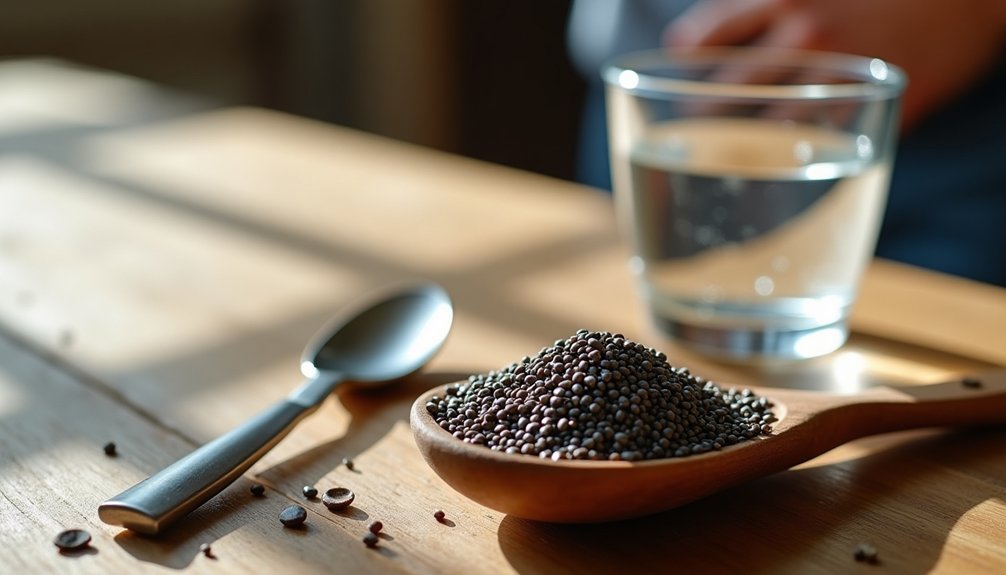
Chia seeds pack substantial nutritional value into small amounts, making the teaspoon a practical unit of measure for managing daily intake. A single teaspoon weighs approximately 4.5 grams and delivers between 0.84 and 1 gram of protein, 0.25 grams of net carbohydrates, and meaningful amounts of omega-3 fatty acids, calcium, magnesium, and antioxidants. Despite this density, the contribution to overall calorie and carbohydrate totals remains minimal at the teaspoon level.
The same fiber content that makes chia seeds beneficial also creates digestive risk when intake increases too quickly. While 2 tablespoons daily is considered safe for most people, providing around 10 grams of fiber, jumping to that amount without preparation can cause bloating and gas. A quarter cup delivers 11 grams of fiber, an amount the digestive system struggles to handle without gradual adjustment.
The recommended approach is to begin with one teaspoon in the morning alongside breakfast and, if tolerated, another later in the day. Increasing the amount should only follow confirmed tolerance, with the body’s fiber response as the primary guide. Keeping intake at one teaspoon or less also preserves the benefits associated with intermittent fasting, since the caloric contribution stays negligible.

Hydration matters alongside the gradual introduction. The foundational ratio is 1.5 teaspoons of chia to three-eighths of a cup of liquid, approximating a 1:6 ratio by weight, with 10 grams of chia requiring 180 grams of liquid for 98% hydration within two hours. Falling below a 1:5.5 ratio risks gritty, unhydrated granules, while exceeding 1:6.5 causes liquid separation. Separation can be corrected by adding 0.5 teaspoon more chia per quarter cup of excess liquid.
Preparation is straightforward. Chia seeds do not require grinding and absorb liquid directly. Stirring vigorously for 60 seconds produces thicker textures. Whole chia seeds form a resilient 3D network that ground chia cannot replicate, making them the superior choice for achieving consistent gel structure. They can be added to water, yogurt, oatmeal, salads, or baked goods without modification.
The health benefits, including improved LDL cholesterol, blood pressure, bone strength, and weight management through fiber-driven satiety, scale proportionally with consistent and controlled use.