


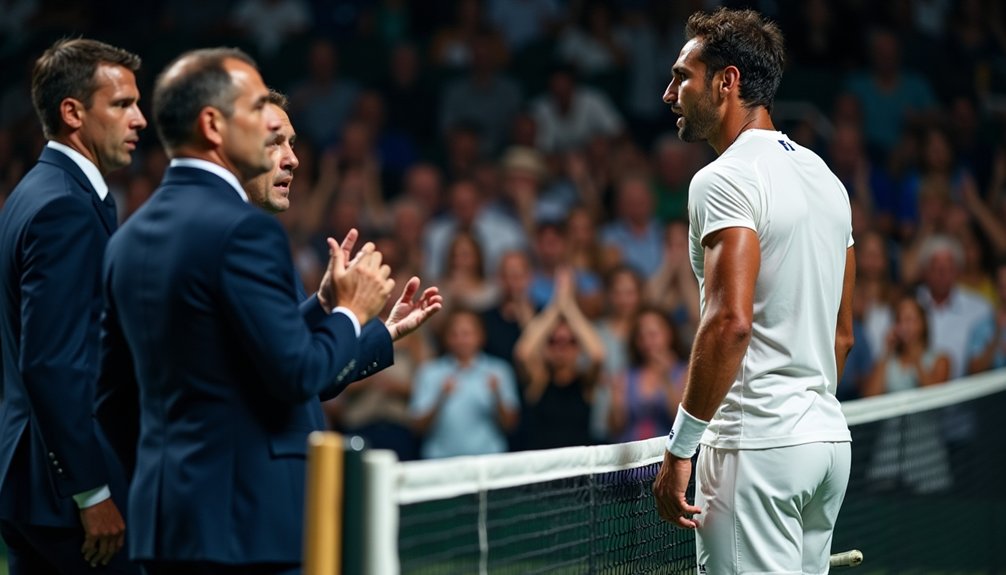
The French Tennis Federation‘s decision to retain human line judges for the 2026 Roland Garros tournament has drawn widespread criticism, leaving the French Open as the sole Grand Slam resisting electronic line calling after Wimbledon completed the change in 2025. The Australian Open and US Open adopted electronic systems in 2021, and the ATP men’s tour eliminated line judges entirely at the start of 2026, making Roland Garros an increasingly isolated holdout.
The FFT defended the decision by citing the “excellence of French umpiring, recognized throughout the world.” Vice president Lionel Ollinger stated the tournament would “continue to show off” that excellence, while president Gilles Moretton claimed France produces the best referees on the professional tour. A federation press release praised umpiring that “brings complete satisfaction to the organization of the tournament.” The announcement came on September 28, 2025.
The FFT cited “excellence of French umpiring, recognized throughout the world” to justify retaining human line judges at Roland Garros.
The decision arrived amid fresh scrutiny of human officiating at Roland Garros. During the 2025 tournament, Novak Djokovic protested a backhand call ruled out at deuce in his semifinal against Jannik Sinner. In the men’s final, a ball was called “in” when replay confirmed it was out by 31mm. Electronic line calling would have immediately resolved both disputes.

The French Open employs 404 refereeing officials, with 284 being French nationals.
Wimbledon’s own 2025 shift to electronic line calling was not without problems. Emma Raducanu reported “very wrong” calls, Jack Draper suggested missed calls contributed to his second-round defeat, and a system malfunction forced a shutdown during a match between Anastasia Pavlyuchenkova and Sonay Kartal. A glitch also called a fault on a live point during Taylor Fritz’s quarterfinal. Pavlyuchenkova herself claimed that a game was unfairly taken from her as a result of the malfunction.
Social media reaction to the FFT’s announcement ranged from skeptical to sharply critical. Commentators pointed out that clay, which leaves visible ball marks, requires line judges the least of any surface. Others noted the irony of Wimbledon, long associated with tradition, adopting the technology before Roland Garros.
Players now face inconsistent officiating standards across Grand Slams, a disparity the ATP has effectively resolved at tour level but that Roland Garros appears unwilling to address.